
2025 Youth Fellowship Projects
Katie Kaisaki

I go to Seattle University as a Chemistry major, I’m a Yonsei, and my grandma and her entire side of the family all went to Minidoka when she was just a baby. I had applied because I thought it would be an interesting opportunity for me to see the camps and to learn more about my families history and the overall history of Japanese Americans. I had heard about them and learned a bit from schools, but not to the degree of which I did while at Minidoka.
Favorite part of Pilgrimage
My favorite part of the pilgrimage was going to Minidoka in person. I enjoyed the part of when we were at Minidoka to be my favorite part. I wish I could’ve stayed in the community house building more as there was so much there I still wanted to read and learn, the information books, the interlude, the wall, each artifact there, I really enjoyed being on the land instead to explore and learn about the history through our tours. Getting to hear stories from elders within my group and how they were connected was also really interesting to me, especially when I saw someone replicating being a pitcher at the field only to hear later on that his father was the captain of the baseball team. I have a picture of him posing and it just felt really special to see.
Project
My project was of drawing the baseball field in different art styles, specifically the ones I saw around camp while walking around, there was a beautiful embroidered piece that I saw in person of the barracks, and some water color ones I saw of the river on the information boards close to it. As well as many other mediums when I look online. I chose this though because art used to always be a big passion of mine, it slowed a lot in college but is still something I enjoyed. So, I thought it would be neat to draw in different styles, a picture of the same baseball field that I took as this was one of my most memorable spots that I got to see because of the story of elder I got to hear while I was on the tour. (Stated above in my “what’s my favorite part of the pilgrimage”.)
Link to Katie's artist statement


Xander Vallier

My name is Xander Vallier and I am currently a freshmen at the University of Washington. I am Yonsei and my Grandmother was incarcerated at Minidoka when she was a child. After going on the pilgrimage in 2019 and having a great experience, I wanted to go again. The fellowship was the perfect opportunity for me to not only be able to visit again, but also
Favorite part of Pilgrimage
My favorite part of the pilgrimage was definitely the tour of the site. The on site museum was incredible and hearing first hand accounts and stories from survivors as we toured the barracks and mess hall was super powerful. Even though it was second time visiting the site, I still learned so much.
Project
I was lucky enough to work with King 5 to get footage and photographs for a story they were doing on the Pilgrimage and Fujuki Garder, a survivor who was in attendance. I am passionate about photography so this opportunity was super meaningful.


Elliot Okimoto
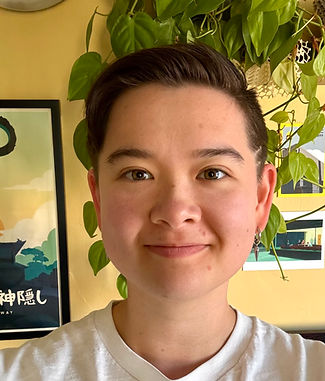
Elliot Okimoto is a yonsei scholar, activist, and descendant of survivors of Poston, Rohwer, and Tule Lake. They're a senior at the University of Washington studying American Ethnic Studies and Linguistics. They're passionate about the Nikkei community, disability justice, and crafting!
Favorite part of Pilgrimage
My favorite part of the pilgrimage was the Wakasa Spirit Stone memorial Obon dance. I felt so connected to my community and my history while dancing with my ancestors around the stone.
Project
Accessibility is important to me as a disabled person and as a person who is passionate about community care. I knew that helping the pilgrimage with accessibility was something I could do to help others experience the healing power of the pilgrimage. It was a perfect way to apply my studies to a part of the Seattle Japanese American community I really care about.
Natalie Tokita

I am a current third-year Human Biology & Society and Asian American Studies student at UCLA! As a yonsei Japanese American and second-generation Chinese American, I have always taken interest in my family's history and culture. Both of my Japanese grandparents were born in Minidoka, so I applied to the fellowship in order to accompany my grandmother as she returned to the place she was born for the first time.
Favorite part of Pilgrimage
I loved the talk story groups and getting to know other pilgrims in such an intimate and welcoming space.
Project
My piece is called "Yonsei," representing not only my generation of Japanese Americans, but also my taiko team's signature song representing my passion for my culture. I attempted to connect the many complex threads of incarceration, culture, language, music, art, and resilience into a work that alternates between different spaces and times but ultimately encapsulates the boundless love that I have for my grandmother.


Tressa Kiku Paulson

I am a student at the University of Washington in Seattle studying linguistics and Japanese, and I will graduate in 2026! I am gosei and a descendant of Japanese Americans incarcerated at Poston and Manzanar. Going to Minidoka with other community members from the Seattle area and beyond was so impactful and I am so grateful for the opportunity.
Favorite part of Pilgrimage
I felt inspired learning about the James Wakasa Memorial Stone, and I enjoyed doing bon odori with the replica lit up in the evening.
Project
I was interested in learning about gardening during incarceration, so I chose to create an embroidery piece of plants found at Minidoka.
Many ornamental plants were brought to Minidoka by Japanese Americans. Three of these were lilac, roses, and black locust trees which still remain at the site. When I visited Minidoka last summer, I was able to see the lilac bush looking out of place surrounded by desert plants. Sagebrush and greasewood are both plants native to Southern Idaho and were used by gardeners incarcerated at Minidoka.
This art piece would be a nice floral embroidery on its own, but I added barbed wire to reflect the reality of gardens in incarceration camps. There was so much amazing art produced by incarcerated Japanese Americans, but it makes you wonder, why were such beautiful gardens hidden away in the desert? Why were these incredible gardeners, artists, regular people who committed no crimes imprisoned within barbed wire? Japanese Americans did what they could to create a life for themselves, but no matter how beautiful the gardens and flowers, we cannot forget all the injustices that they faced. No one deserves to be imprisoned due to their ethnic background or place of origin.
Special Thanks to Anna Tamura for answering all my questions about gardens at Minidoka.
